Nourishing Communities: Nutrition Education That Works
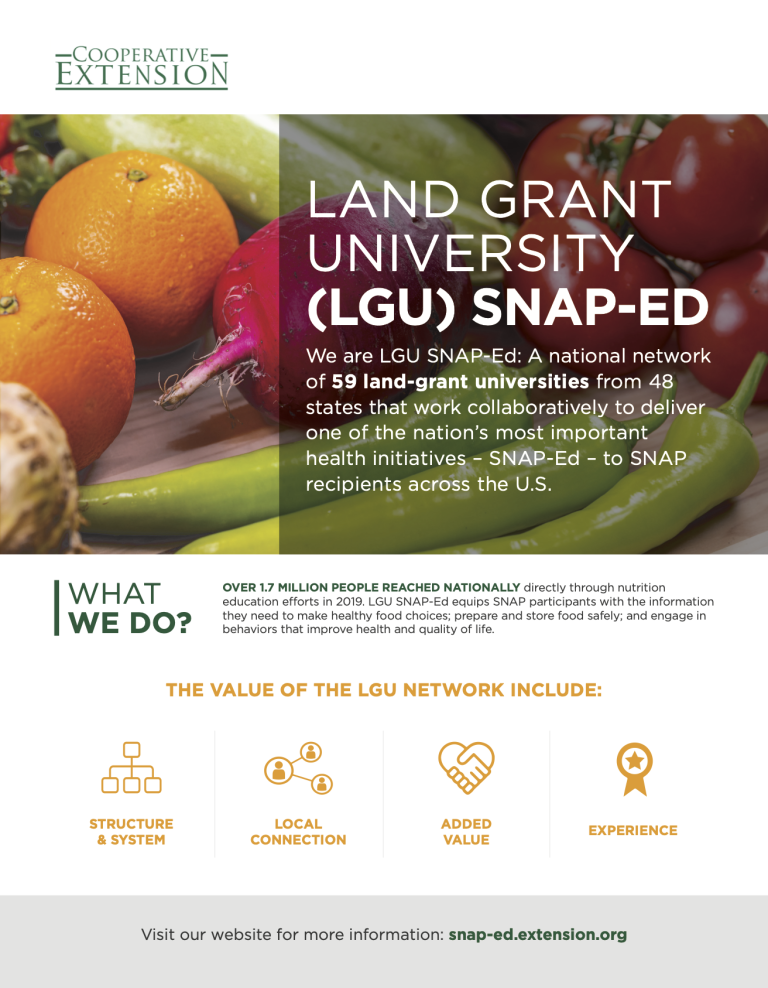
The Land-Grant University (LGU) Supplemental Nutrition Assistance Program Education (SNAP-Ed) Program Development Team has created the Nourishing Communities: Nutrition Education That Works website to provide decision-makers with information about how LGUs deliver SNAP-Ed to communities across the nation. We are LGU SNAP-Ed, a national coalition of 58 land-grant universities that work collaboratively to deliver one of the nation’s most important health initiatives – SNAP-Ed – to SNAP recipients across the U.S. We hope that this information helps you better understand SNAP-Ed and the critical role that LGUs play in delivering this vital program to millions of Americans each year.
About SNAP-Ed
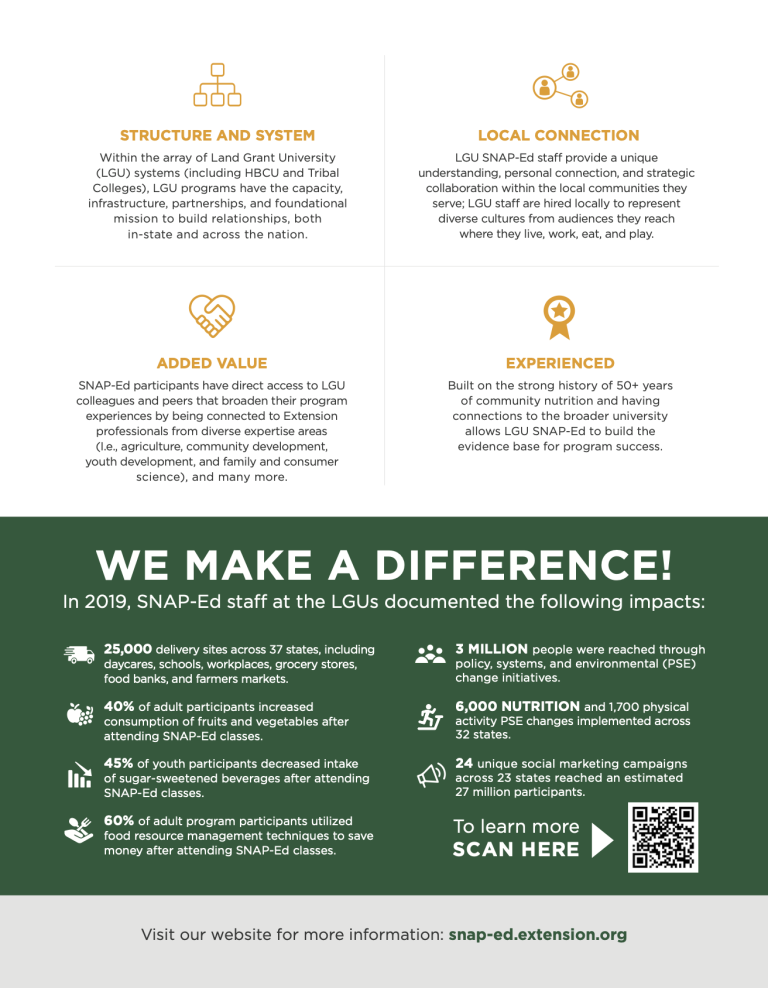
SNAP-Ed paves the way for positive behavior changes that lead to improved health for individuals and communities. The goal of SNAP-Ed is to improve the likelihood that SNAP-eligible Americans with lower income will make healthy food and lifestyle choices that prevent obesity. LGU SNAP-Ed equips SNAP participants with the information they need to make healthy food choices; prepare and store food safely; and engage in other behaviors that improve health and quality of life.
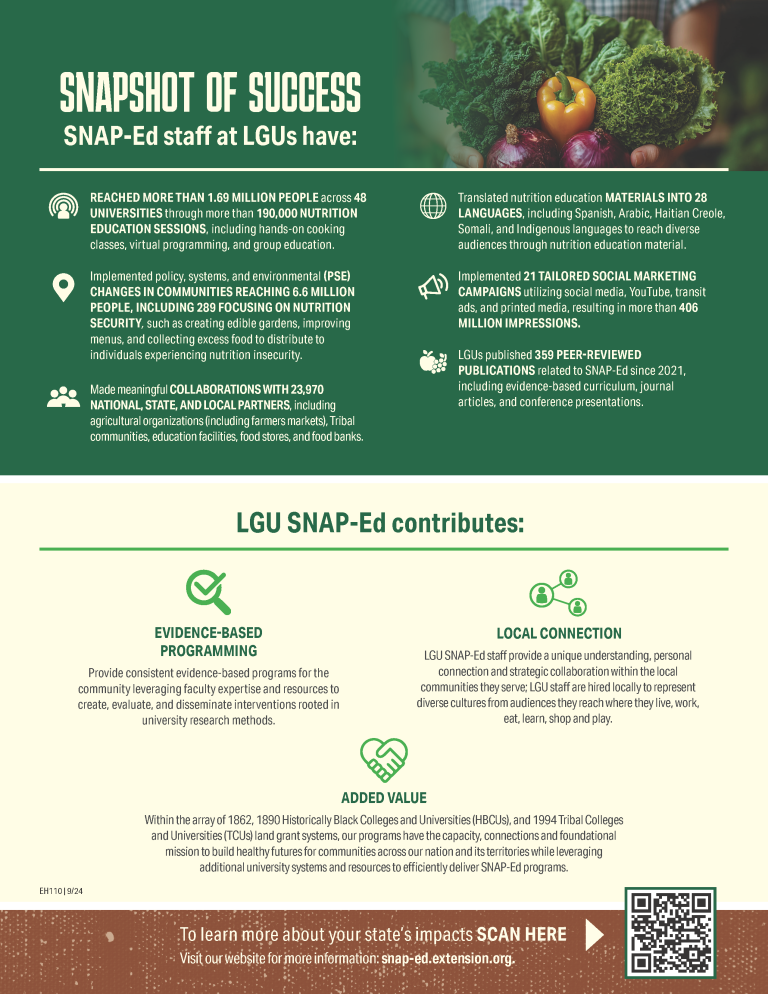
A report of 2024 LGU SNAP-Ed impacts include:
- 1.69 million people across 48 universities through more than 190,000 nutrition education sessions.
- Implemented policy, systems, and environmental (PSE) changes in communities reaching 6.6 million people, including 289 focusing on nutrition security.
- Made meaningful collaborations with 23,970 national, state, and local partners.
- Translated nutrition education materials into 28 languages.
- Implemented 21 tailored social marketing campaigns utilizing social media, YouTube, transit ads, and printed media, resulting in more than 406 million impressions.
- LGUs published 359 peer-reviewed publications related to SNAP-Ed since 2021, including evidence-based curriculum, journal articles, and conference presentations.
SNAP-Ed Across the Lifespan
Of 360+ programs in 48 universities
1.69
million people
reached
23,070
national, state and
local partners
28
translated languages t
to reach audience
359
peer reviewed publications since 2021

Program Delivery
SNAP-Ed helps reduce the incidence of obesity and chronic disease by improving dietary habits and increasing physical activity. We equip program participants with life skills that help them stretch their food budget, improve food safety, and feel empowered as consumers to make healthy choices. We work with people across the lifespan, from early childhood to senior citizens. You’ll find LGU SNAP-Ed programs wherever people live, learn, work, play, shop, and eat. We use different educational strategies to reach our audiences, including direct delivery and social marketing. At the population and community level, our programs focus on policy, systems, and environment interventions that can create positive systemic change.
Who We Are
We are LGU SNAP-Ed, a national coalition of 58 LGUs that work collaboratively to deliver one of the nation’s most important health initiatives – SNAP-Ed – to SNAP recipients across the U.S.
We are a unique coalition. While all universities are places of research and teaching, LGUs have a critical third mission: Cooperative Extension. “Extension” education focuses on connecting communities to LGUs through community outreach and education.
Extension is the community presence of LGUs, based in thousands of county offices across the nation. Extension provides trusted outreach and education in agriculture, food and nutrition, natural resources, and youth and family development. This education helps people and communities solve problems, build capacity, and create a better future. Our Extension work includes delivering the critically important SNAP-Ed program.
Learn more about how we are structured and our history in the Extension 101 section.
A powerful national network that is deeply embedded in local communities
LGU SNAP-Ed leverages an expansive national network of Extension expertise and relationships in complementary programs, including the Master Gardeners; mental health/adverse childhood experiences programs (focusing on resilience); Small Farm education; community vitality and development; 4-H youth development; and strengthening families and consumer science programming. This network of relationships provides SNAP-Ed participants access to other Extension programs and resources.
Our work complements the Expanded Food and Nutrition Education Program (EFNEP). The relationship with EFNEP enables us to maximize our resources through efficient administration and reduced overhead costs. Our affiliation with EFNEP enhances our ability to reach target audiences.
We have other unique strengths, including access to the most current research, dietetics internship programs, medical schools, public health programs, and food system faculty. We leverage thousands of volunteers who serve communities as part of the SNAP-Ed team.
We learn from one another and share information. Best practices and successful programs developed and delivered by individual LGUs are shared with the national network, effectively leveraging the innovative work of individual institutions to benefit multiple states.
LGU SNAP-Ed prioritizes deploying staff resources in communities. Program delivery staff comprise the majority of personnel for LGU programs, with a significant percentage of our staff serving as community-based educators. Members of our program team often live in the communities they serve.
With a direct Extension presence in most states and U.S. territories, LGUs lead or play a critical role in SNAP-Ed delivery. LGUs have forged strong partnerships with others to deliver SNAP-Ed, including state SNAP programs; Women, Infants, and Children (WIC) offices; departments of education; schools (K-12 and higher education); health departments; food banks; and nonprofits.
Extension 101
Among higher education institutions in our nation are land-grant universities (LGUs). All universities engage in research and teaching, but LGUs have a third mission area: Extension. Extension connects communities to LGUs through community outreach, education, and engagement. The Extension mission of LGUs is delivered by Cooperative Extension (CE). There are thousands of CE offices across the U.S. which bring the resources of their university to the people. For more information on other Extension priorities, visit Advocacy Toolkit.